

You might wonder about this picture - but it is sent to you courtesy of Shozu (see logotype). Cute. Check it out.
20070514
Cute but useful ?
You might wonder about this picture - but it is sent to you courtesy of Shozu (see logotype). Cute. Check it out.

20070120
A better place ?
Intermezzo: 90 days in and counting.
I have previously mentioned my two professional passions: research and teaching. I also tried to give you some idea of the difference I see right now between my past and my future, research-wise (very little and all positive). But what about teaching?Will I Am I missing the contact with new students, these first months of the academic year? Does a bear poo [1] in the woods?
Teaching is very much part of my core. Be it an theoretical course or a practical session, it does a great job of keeping me warm and fuzzy. Wrapped in the very fabric of the field, I can reach out and connect. I have always imagined that few things are more satisfying than the development (pun intended - read the previous posts) of a course from scratch. To inspire students and give them a foundation to build on. To rise and never fall. To boldly go... Let it be clear: the opportunity to teach can make me put up with a lot (but only so much). It also forces one to keep the fundamental truths of the chosen path in mind.
The current views on higher (college, university or should that be universal) education are being twisted by strategic planning. Somehow, even the shortest introduction to a field has to have "finality" and direct application to some industrial problem when the student graduates. Value in the job market. These values are, unfortunately, not in favour of the great teachers becoming renowned higher educators. Paranoia? Maybe. Even more unfortunately, they are also not in favour of great researchers becoming great teachers. It makes them become managers. The world does not need more managers.
Recently, someone asked me why people with a physics background seemed to fit into the telecom world so easily, no matter what their original field. Helloooooo ? In the spirit of the great Balmer, all together now
Let this be a plea to all the teachers in higher education: teach the truths, not the worn down tracks ! End of idealistic rant (who needs coherence in a blog post anyway?).
[1] More about about poo/Poo/Pu in a later post.
I have previously mentioned my two professional passions: research and teaching. I also tried to give you some idea of the difference I see right now between my past and my future, research-wise (very little and all positive). But what about teaching?
Teaching is very much part of my core. Be it an theoretical course or a practical session, it does a great job of keeping me warm and fuzzy. Wrapped in the very fabric of the field, I can reach out and connect. I have always imagined that few things are more satisfying than the development (pun intended - read the previous posts) of a course from scratch. To inspire students and give them a foundation to build on. To rise and never fall. To boldly go... Let it be clear: the opportunity to teach can make me put up with a lot (but only so much). It also forces one to keep the fundamental truths of the chosen path in mind.
The current views on higher (college, university or should that be universal) education are being twisted by strategic planning. Somehow, even the shortest introduction to a field has to have "finality" and direct application to some industrial problem when the student graduates. Value in the job market. These values are, unfortunately, not in favour of the great teachers becoming renowned higher educators. Paranoia? Maybe. Even more unfortunately, they are also not in favour of great researchers becoming great teachers. It makes them become managers. The world does not need more managers.
Recently, someone asked me why people with a physics background seemed to fit into the telecom world so easily, no matter what their original field. Helloooooo ? In the spirit of the great Balmer, all together now
Fundamentals, fundamentals, fundamentals, fundamentals, fundamentals, ...
Let this be a plea to all the teachers in higher education: teach the truths, not the worn down tracks ! End of idealistic rant (who needs coherence in a blog post anyway?).
[1] More about about poo/Poo/Pu in a later post.
20061025
Dear blogophile,
 This piece by William Safire in the On Language section of the NYT had me smiling/resonating all the way to the office.
I sympatize with our dear William. In Dutch, the equivalent salutation would be "Beste William" ("Dear William") or the possibly more formal "Geachte William". However, in a twist not mentioned in the article, I often catch myself writing just "Beste," ("Dear,") when writing a multi-recipient email. Doesn't it look lonely:
Dear,A bit like finishing a letter or email with just "Yours," — I have done it, but am never sure if I am being too forward or too abrupt.
Where is that promise of office automation (Thunderbird plugin developers, are you listening?) that would allow me to have multiple parties in my To:-list and just
Dear [first name],as a salutation. Or even better
salutation([first name]),where depending on the person in question, the salutation function generates "Dear William", "Hey Will", "Da man W." or, when it senses my state of mind just
""
And with that vision that one day all emails will be templated, automated and impersonal, I urge you to accept, Dear blogophile, the expression of my most respectful sentiments,
M.
20061024
Draw me a war
The item that ticked me off has been floating around the blogosphere for a quite a while already (I picked it up @ Daring Fireball), but it is still bothering me. Badly.
The question I would like to address is : "Have they gone completely bonkers!?!?". They referring to the citizens of that greatest nation on earth .
Of course, Texas may be an isolated hotbed of silliness, but I doubt it. You see, they have tried to forbid Fahrenheit 451 as appropriate reading material for high school students. All because of a complaint by someone that hasn't even (he admits) read the book. The irony is goddamn' beautiful.
Now, that very irony has been discussed in several places and the idiocy been exposed in most eloquent ways. What bothered me even more was the snippet halfway through (sorry, the original content is no longer available for free, but the google cache is still available) when other banned books were discussed. One of them being:
Let me show you this evil book:

I must be a horrible parent, I have read that very book to my children several times. And I cannot think of a single reason why it should be forbidden. Nor can understand that this was not front page news - I guess you get used to stuff like this when you live in the States. Go get it at a local library (a become a patron while you're at it!) - it has been translated into a number of languages. Then, join me in my passionate plea to the NCIS:
The question I would like to address is : "Have they gone completely bonkers!?!?". They referring to the citizens of that greatest nation on earth .
Of course, Texas may be an isolated hotbed of silliness, but I doubt it. You see, they have tried to forbid Fahrenheit 451 as appropriate reading material for high school students. All because of a complaint by someone that hasn't even (he admits) read the book. The irony is goddamn' beautiful.
Now, that very irony has been discussed in several places and the idiocy been exposed in most eloquent ways. What bothered me even more was the snippet halfway through (sorry, the original content is no longer available for free, but the google cache is still available) when other banned books were discussed. One of them being:
"NCISD banned "Draw Me a Star" by Eric Carle and "Absolute Power" by David Baldacci, but it has not received a book challenge in three years, Cindee Reynolds, NCISD superintendent/community relations executive assistant, stated in an e-mail to The Courier."
Let me show you this evil book:

I must be a horrible parent, I have read that very book to my children several times. And I cannot think of a single reason why it should be forbidden. Nor can understand that this was not front page news - I guess you get used to stuff like this when you live in the States. Go get it at a local library (a become a patron while you're at it!) - it has been translated into a number of languages. Then, join me in my passionate plea to the NCIS:
STOP IT, YOU SILLY BUGGERS !
Fundamentalism
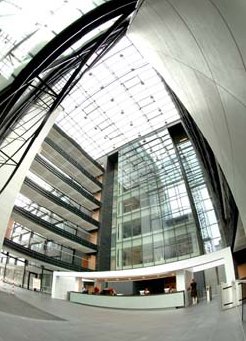
The previous installment might have been a bit dry to your taste (as descriptions are wont to be). You got the message: I have my new building (sorry, couldn't resist). Promises, promises... In any case, I hope to have give you some idea of my time and space allotment - what about the rest of the framework?
State of the system
To understand how I feel right now, you need to hear my take on the entire fundamental/basic/strategic/applied/industrial research situation. Short version: I think the impulse give by the different authorities has caused academic departments to overshoot the intended mark (welcome, mixed metaphoric friends).
Postulates
When I started at the VUB, I was passionate about two things: research and teaching. I had no clue at that time that there were "different" kinds of research (the eternal sunshine of the spotless mind):
- fundamental
- basic
- strategic
- basic strategic
- applied
- industrial
all in contrast to development. Notwithstanding all the subcategories, I have realized that this is true: either you are doing research or you are doing development. The big players in industry have understood this and it can be noticed in the subtle change in naming from R&D to R&I (innovation); development has been moved to were it belongs, the product groups, and innovation to the CTO (to understand the main reasons: read Christensen, Clayton M. (1997). The Innovator's Dilemma. Harvard Business School Press. ISBN 0-87584-585-1).
Unfortunately, only too often smaller companies (so called SMEs) do not make this distinction and their approach to research (pronounced [development]) is poisoning what I prefer to call Research (not pronounced [consulting]). Yes, apparently Europe wants it this way. With SMEs guiding the process. Wrong! What Europe wants is the transfer of (applicable) knowledge. Nowhere have I read that Research groups should mimic or try to behave like SMEs.
Funding organizations try to force the more basic aspects at a fundamental level by reducing the support for development a.k.a. research. Unfortunately this only causes the directors of research at academic institutions to redefine the meaning of "fundamental" and "basic". And since the experts that evaluate the proposals are often the very same that submit proposals, MUWAAAHAHAHAAAHAHAHAHA !!!
Now, I have become part of an R&I group. We do research (not Research, which is left to our academic partners) and R&D is another group, which is refreshingly and uncharacteristically honest for the private sector. If at times I stumble across something which is Research, all the better. At the very least I am not kidding myself, and nobody else is trying to kid me either. Simple litmus test:
- development leads to products - to be sold
- research leads to inventions - to be patented
- Research leads do discoveries - to be celebrated
And there you have your axioms/postulates. Let me make one (1) thing clear: there are no value judgements here. But if your job is supposed to be about Research, then research is a close relative and development a distant neighbor.
Elementary, my dear Watson.
P.S. For the record: I do not believe that Research is only possible in an academic context.
20061010
Epsilon/Delta

I am finally more or less settled in. The past two weeks were filled with getting to know a lot of nice new people, taking care of 1001 administrative formalities, initiating the study of the new field I'll be working in, taking initiation courses and having panic attacks.
It is said that change can be like a breath of fresh air. Don't get me wrong, I like fresh air - but at the moment I am feeling like a lifelong inner-city dweller tied to the front of an ocean liner in the middle of the Atlantic/Pacific. I am not in want of fresh air, let me assure you. And the salty brine bites, man.
All hyperbole aside, are there real differences between academia and Alcatelia? Was I working in an ivory tower before? Is there a reason why I cannot get to the point and start giving answers instead of questions ? Taking my cue from basic physics, I will try and organize the changes by
- defining time
- defining space
- giving the axioms/postulates
- describing the state of the system
- describing the theoretical/experimental tools
Time
There
But in practice, things are much less worse. Tele/Homeworking is actively promoted and supported through the availibity of a personal laptop (no, not Apple) with all necessary trimmings, a VPN connection and refunding of your cable/DSL access cost. And you can of course save up every minute you stay longer to leave early when needed, or to take an extra day off. You see, there is this silly clocking system, but you can start at any time before 10:00, and leave from 15:30 onward. And I have almost one hour overtime just after two weeks. Time will not be a problem.
Space
To return to the coffee after lunch remark, luckily there are semi-decent coffee-machines on every floor, serving everything from expresso to some soup-like concoction. So you can have your latte at your desk. Except that it is not your desk. The official term for this lack of private space is Open/Shared Office and it is supposed to promote team work and flexibility. You come in, in the morning, and sit down at either a free
- open desk (theory: promotes team interaction)
- grouped semi-shielded desk (theory: promotes one-on-one interaction)
- shielded desk (theory: for those focussed-leave-me-alone sessions)
- or you can always move to a number of meeting rooms if you need to shout at a colleague.
You plug in your portable, connect a free 19" screen to have some extra real-estate and log into the VoIP phone system (hey, if Alcatel cannot pull it off, who can?) so your callers can find you and there you go.
Oh, did I mention the clean desk policy? (I can see you smiling, cut it out) In the evening, the desk has to be empty and clean again - and I was worrying about the clock...
To be continued.
20060908
Where it all ends/begins
A change of job, a change of environment, after 10 years, what it is good for (anyway)?
An answer to this question is hard to come by. Chances are that after a few months, ALCAIC will have evolved away from trying to answer it. Or so I hope. Initially however, the main reason for it to exist is to document my move from academica to ... to what, exactly? Frankly, I do not know.
The sudden change in itself generates a number of obvious questions. Let me keep the "why?" and "why now?" for a future post. The "why Alcatel?" is easy on the surface: because they asked.
Networks are funny things. Ask any physicsist/engineer and they will tell you stories about feedback and coupling, instabilities and emergent properties. Small changes to the input can generate large changes in the state of the system. Chaos, quoi. Behaviour so unpredictable that it appears to be random. The verb here is appears.
People are funny creatures. Ask any psychologist/emotionally intelligent person and they will tell you stories about feedback and coupling - uh, wait a second. Anyway, people can be preoccupied and unhappy with their current situation but still in a stable state. After all, we are or try to be rational (linear?) beings, no? Small changes to our environment do no cause (most of) us to become unstable, to switch, if you want. Enter the network.
Although we can try and stay at a fixed point, our preoccupied state of mind generates signals which drive your social network into 1) generating feedback and 2) rapidly changing its global state around you. This is exactly the counterintuitive value of a good network: the bigger it is, the better it can react. Some HR people will say "let the network work for you", and that is in my opinion spot on. But beware of the genie in the bottle that acts on all your wishes. Small wishes can have large consequences.
Anyway, my social network picked up on my signals, provided feedback and just before the holidays Alcatel called and asked me if I could send my CV and come over for a discussion about possible interesting opportunities. They were interesting and there you go. So now I have anecdotal evidence that networking works - the next step is figuring out how to do it in a controlled way. Chaos control, anyone?
But maybe all of the above is just rationalisation, and it was all guided by a secret consipracy of freemasons. I was meant to go to Alcatel. After all, the prominent use of an inverted triangle (piramid) in both logos is suspicious, no?

Next to this, the name Alcatel comes from "Société Alsacienne de Constructions Atomiques, de Télécommunications et d' Electronique". And wasn't this region a known centre of masonic activities with the presence of e.g. Philippe-Jacques Franck, a freemason and one of the wealthiest and most influential personalities in Strasbourg (bonus points if you can tell me where the conference on photonics is organized every 2 years). And don't tell me you cannot see other obvious clues...

An answer to this question is hard to come by. Chances are that after a few months, ALCAIC will have evolved away from trying to answer it. Or so I hope. Initially however, the main reason for it to exist is to document my move from academica to ... to what, exactly? Frankly, I do not know.
The sudden change in itself generates a number of obvious questions. Let me keep the "why?" and "why now?" for a future post. The "why Alcatel?" is easy on the surface: because they asked.
Network dynamics
Networks are funny things. Ask any physicsist/engineer and they will tell you stories about feedback and coupling, instabilities and emergent properties. Small changes to the input can generate large changes in the state of the system. Chaos, quoi. Behaviour so unpredictable that it appears to be random. The verb here is appears.
People are funny creatures. Ask any psychologist/emotionally intelligent person and they will tell you stories about feedback and coupling - uh, wait a second. Anyway, people can be preoccupied and unhappy with their current situation but still in a stable state. After all, we are or try to be rational (linear?) beings, no? Small changes to our environment do no cause (most of) us to become unstable, to switch, if you want. Enter the network.
Although we can try and stay at a fixed point, our preoccupied state of mind generates signals which drive your social network into 1) generating feedback and 2) rapidly changing its global state around you. This is exactly the counterintuitive value of a good network: the bigger it is, the better it can react. Some HR people will say "let the network work for you", and that is in my opinion spot on. But beware of the genie in the bottle that acts on all your wishes. Small wishes can have large consequences.
Anyway, my social network picked up on my signals, provided feedback and just before the holidays Alcatel called and asked me if I could send my CV and come over for a discussion about possible interesting opportunities. They were interesting and there you go. So now I have anecdotal evidence that networking works - the next step is figuring out how to do it in a controlled way. Chaos control, anyone?
Coincidence ?
But maybe all of the above is just rationalisation, and it was all guided by a secret consipracy of freemasons. I was meant to go to Alcatel. After all, the prominent use of an inverted triangle (piramid) in both logos is suspicious, no?

Next to this, the name Alcatel comes from "Société Alsacienne de Constructions Atomiques, de Télécommunications et d' Electronique". And wasn't this region a known centre of masonic activities with the presence of e.g. Philippe-Jacques Franck, a freemason and one of the wealthiest and most influential personalities in Strasbourg (bonus points if you can tell me where the conference on photonics is organized every 2 years). And don't tell me you cannot see other obvious clues...

Subscribe to:
Posts (Atom)


 Posts
Posts


